
Estimated Read Time: 6 minutes
Table of Contents
- Why the Usual North Indian Menu Feels Too Familiar
- What North Indian Food Actually Includes
- Gulaabo Ji: Built Around Revival, Not Repetition
- A Menu That Travels Through Regions
- Slow Food, On Purpose
- Why Assagao Is the Right Place for This
- Frequently Asked Questions
Key Takeaways
- Most North Indian menus in Goa tend to repeat the same familiar comfort dishes, from butter chicken and dal makhani to paneer tikka and garlic naan.
- Genuine regional North Indian food carries the memory of specific places such as Awadh, Bihar, Punjab and Kashmir.
- Gulaabo Ji, a North Indian restaurant in Goa, begins with North Indian comfort and opens the table to regional Indian recipes that go beyond the usual curry-house format.
- The menu brings together slow-cooked dishes, forgotten recipes, old-school hospitality, retro nostalgia and Indian flavours from different regions.
- In a village where Assagao food has become known for personality and slower dining, Gulaabo Ji adds a nostalgic Indian dining experience with its own point of view.
When most people think about North Indian food, the same dishes usually appear first.
Butter chicken. Dal makhani. Paneer tikka. Garlic naan.
There is nothing wrong with any of them. Comfort food becomes comfort food for a reason. But somewhere along the way, North Indian food on many restaurant menus got reduced to a predictable set of favourites.
A few Punjabi and Mughlai dishes began standing in for a region that is much larger, older and more layered than most menus suggest.
Goa’s diners have become more curious. They still enjoy familiar Indian comfort, but many now want dishes with a place, a story and a reason to be on the menu. Diners from North India also want meals that feel closer to home, not just restaurant versions of what everyone already knows.
At Gulaabo Ji, we wanted to bridge that gap.
We are a retro Indian diner in Assagao built around memory, comfort, slow cooking and recipes that deserve to be brought back to the table. The idea is not to reject the usual North Indian favourites. The idea is to go beyond them.
Why the Usual North Indian Menu Feels Too Familiar
Many restaurant menus use the phrase North Indian food, but the experience often feels the same from place to place.
There may be a creamy gravy section, a tandoor section, a biryani section and a few breads on the side. The names change slightly, but the pattern is familiar. The result is enjoyable, but it can also feel flat.
The problem is not the food itself.
The problem is repetition.
A cuisine becomes smaller when only its most familiar dishes are served over and over again. North Indian cooking carries courtly kitchens, home recipes, street snacks, village food, regional breads, festival dishes and slow-cooked meats. It carries stories from Lucknow, Punjab, Bihar, Kashmir, Delhi and beyond.
When all of that becomes only butter chicken and naan, something gets lost.
That is what Gulaabo Ji tries to bring back.
What North Indian Food Actually Includes
North India is not one single cuisine.
Awadhi cooking from Lucknow is known for subtle spice, slow cooking, kebabs, rich gravies and a sense of restraint. Bihar has its own deeply rooted food traditions, from litti chokha to Champaran-style mutton cooked slowly in a sealed handi. Punjab brings tandoor, dairy, whole spices, robust gravies and generous hospitality. Kashmir brings its own ingredients, techniques and vegetarian as well as meat-led traditions.
That is only one part of the larger Indian table.
At Gulaabo Ji, we begin with North Indian comfort, but we do not stop there. The menu also makes room for regional Indian dishes from places such as Bengal, Hyderabad, Maharashtra, Chettinad and Malabar. These are not all North Indian regions, and they should not be flattened into one category.
The point is simpler.
Indian food has far more memory than most menus allow.
Real regional North Indian food keeps its identity intact. A Bihari dish should not taste like an Awadhi dish. A Punjabi dish should not be treated like a Kashmiri one. A Bengal-inspired curry and a Hyderabadi biryani should carry their own history, not be turned into generic restaurant food.
That is the difference between serving dishes and serving memory.
Gulaabo Ji: Built Around Revival, Not Repetition
Gulaabo Ji was not built to be another standard North Indian restaurant.
We are a retro diner inspired by the 1980s and 90s, with food, music, interiors and hospitality shaped by nostalgia. But nostalgia here is not just decoration. It is not only old songs, vintage references or familiar flavours.
It is the feeling of food that took its time.
Food from kitchens where recipes were remembered, not rushed. Food that came from homes, journeys, regional traditions, old menus and family-style cooking. Food that made people pause because it reminded them of somewhere, someone or some time.
That is why our food menu is built around revival rather than repetition.
Some dishes are familiar. Some are forgotten. Some come from North India. Some come from other Indian regions that carry the same spirit of memory-led cooking. Together, they create a dining experience that feels rooted, generous and intentionally slower.
For anyone searching for a North Indian restaurant in Goa that offers more than the usual rotation, Gulaabo Ji is built around that difference.
A Menu That Travels Through Regions
The dishes make the point better than any explanation can.
Gulaabo Ji’s menu does not try to turn India into one flavour. It lets different dishes hold their own place, method and memory.
From Awadh, Bihar and Punjab
Gosht Champaran ties back to Bihar’s slow-cooked handi tradition. The mutton is cooked with mustard oil, whole spices, garlic, ginger and time, giving the dish a depth that cannot be rushed.
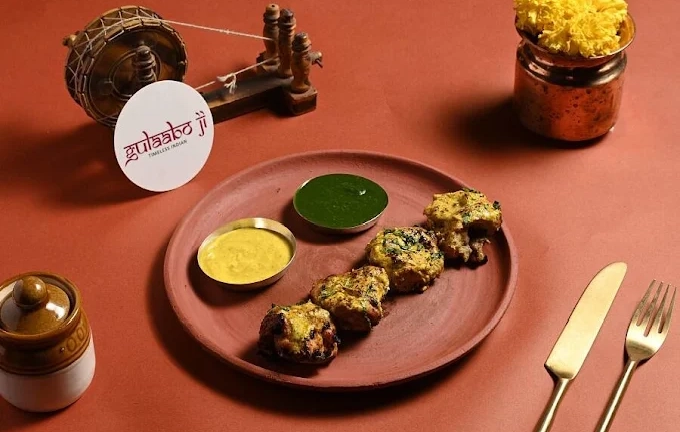
Kakori Kebab carries the memory of Awadhi finesse. It is soft, finely minced, gently spiced and built around texture as much as flavour.
Lucknawi Murg Chaap Masala, served with ulta tawa paratha, brings in the richness and restraint associated with Lucknow’s cooking. The spice does not need to shout. It builds slowly.
Lahori Chargha moves toward a more assertive style, with a whole chicken marinated, steamed and fried into a dish that feels festive, generous and full of character.
From Kashmir, Bengal and Hyderabad
Methi Chaman brings in Kashmiri Pandit cooking through fenugreek, paneer, spinach and spices. It is a reminder that vegetarian food can carry just as much regional identity as meat-led dishes.
Mutton Dak Bungalow revives a colonial-era Bengal classic, cooked with potatoes, boiled egg and a mustard oil-led bhuna masala. It feels like a dish made for travel, memory and comfort.
Kosha Murg and Daab Chingri extend that Bengal connection further, one through slow-cooked chicken and the other through prawns cooked with tender coconut, mustard and cashew paste.
Hyderabadi Kacche Gosht Ki Dum Biryani and Hyderabadi Kacche Murg Ki Dum Biryani bring in the drama of dum cooking, where raw marinated meat and rice cook together under sealed heat.
From Maharashtra, Chettinad and Malabar
Subz Kolhapuri carries Maharashtra’s heat with dry red chillies and bold masala.
Murg Chettinad Tikka brings in curry leaves, coconut milk and freshly ground spices from Tamil Nadu’s Chettinad tradition.
Nilgiri Fish and Prawns Curry move towards green coconut-based flavours, using mint, coriander and coastal freshness instead of the usual tomato-heavy gravy base.
Malabar Moplah Chicken Biryani adds another regional expression of biryani, shaped by coastal spice, rice and memory.
The point is not to collect dishes for the sake of variety.
The point is to let each dish keep its own memory.
That is what makes the Gulaabo Ji menu different from the usual North Indian restaurant format.
Slow Food, On Purpose
Food like this cannot be rushed.
At Gulaabo Ji, slow cooking is not a phrase added for effect. It is part of the way many dishes are meant to be understood. Dum cooking, handi cooking, overnight marinades, slow bhuna masalas and layered gravies all need time.
The pace of the restaurant follows that idea.
Vintage décor. Nostalgic music. No pressure to eat fast and move on. A table where people can talk properly. Food that arrives with enough weight to hold the evening together.
If Gulaabo Ji had to be summed up in one thought, it would be this:
Dine slow, live slower.
That also extends to the bar.
Our bar menu carries the same memory-led spirit, with cocktails inspired by Indian nostalgia, childhood flavours and playful retro references. The food and drinks belong to the same world.
Comfort, memory and a little mischief.
Why Assagao Is the Right Place for This
Assagao gives this kind of restaurant room to breathe.
The village has become one of North Goa’s most interesting food pockets because it allows restaurants to be more personal, more experimental and less rushed. Its quiet lanes, old Goan homes, cafés, boutiques and chef-led spaces have shaped a dining culture that is not only about eating out, but about choosing where an evening should unfold.
That makes Assagao the right home for Gulaabo Ji.
In a village where Assagao food has become known for character and individuality, Gulaabo Ji brings another kind of identity to the table: Indian nostalgia, regional memory, generous hospitality and food that does not apologise for taking its time.
We are a North Indian restaurant in Goa, but we are not interested in serving a flat version of North Indian food. We begin there, then travel wider through regional Indian recipes that deserve attention.
For diners who are tired of the usual menu, Gulaabo Ji offers something more personal.
A meal that remembers where it came from.
A table that lets you slow down.
And a restaurant in Assagao built for people who want Indian food with a little more story.
Visit Gulaabo Ji in Assagao
The usual North Indian menu will always have its place.
But sometimes, diners want more than the familiar order. They want food that remembers where it came from. They want dishes that carry a region, a family memory, a lost recipe or an old-school cooking method. They want a restaurant where the evening slows down instead of moving them along.
That is what we have built at Gulaabo Ji.
A retro Indian diner in Assagao, shaped by nostalgia, slow cooking, regional memory and comfort food that goes beyond the expected.
Explore our food menu, pair it with something nostalgic from the bar menu, or get in touch to plan your visit.
Come hungry. Stay unhurried.
Date : 26-10-2026